• Contact Us
(248) 722-5008
Good Name Advisors
  • About
  • Philanthropic Advising
  • Giving Circles
  • Media/Speaking Engagements
  • Blog
  • Menu Menu
  • About
  • Philanthropic Advising
  • Giving Circles
  • Media/Speaking Engagements
  • Blog
  • Contact Us

On Communal – and Civic – Duty

October 15, 2026

Don’t want to read? Take a listen, here.

Back in the late 1990s and early aughts, one of my responsibilities at the Jewish Federation of Detroit was oversight of a program we called the “volunteer draft.” Staff and volunteer leaders sat together and looked closely at every committee in the Federation system and its supported agencies, and suggested candidates for open roles. We tried to think about what each governing body really needed. More women? They certainly needed younger people on that committee! Someone with a legal background? Fundraising? A marketing and communications mind?

For a while, we held an annual draft. Open positions were posted around a room, and dozens of leaders walked around sticking Post-it notes with names on the committees and boards. Not everyone was nominated, but it let all of us think creatively about skills, matches, and community needs.

The other side of that work was meeting people, getting to know their interests and skills, and thinking about where they might fit. It’s one reason people often tell me, “You know everyone!” (Spoiler: I don’t.) Since then, I’ve sat on many nominating and governance committees, always thinking about the who, where, and how.

I love this work. I think of it as matchmaking for the community-minded. Directly or indirectly, I’ve probably helped “draft” hundreds, if not thousands, of people into community life.

Now that I work for myself, I’ve had the chance to draft myself. I’ve joined a number of boards and committees. And then I faced an interesting question: Could I take what I’d learned in the nonprofit world and bring it to the civic one?

Organizing our local Run 4 Their Lives chapter helped me see that bridge. Bringing neighbors together each week, coordinating with police, making sure we gathered safely, walking and talking with old friends and new ones — it was communal work happening in civic space. I loved it, and I realized the line between the two was thinner than I’d thought.

I’ve lived in our tiny, idyllic village for 25 years. We’re small and surrounded by better-known suburbs. Our main attraction, the Cider Mill, isn’t even technically in the village. We walk the neighborhood almost daily and have come to know many of our neighbors – and if we don’t know them, we probably know their dog.

So when I was approached about running for the Franklin Village Council, I surprised myself, and Eddie too, when I said I’d give it serious thought. Now here I am, running for a four-year term as Franklin Village Trustee.

I believe it’s essential for minority communities to take part in civic life. There are fewer than 16 million Jews in the world, and we can’t afford to sit on the sidelines. Showing up locally, where decisions are made about the streets we walk and the neighbors we know, is one of the most direct ways to do it.

I hope to bring my experience in governance, budgeting, and community organizing to the place I already love. It feels like the next natural step.

To be clear, this isn’t a fundraising letter. (We’re a lean, mean, local organizing machine.) If you live in Franklin, yes, I’d love your vote. But mostly I’m sharing this as one more way to be engaged in community. And if you’re wondering about the philanthropy angle: if elected, I’ll donate my entire council salary to charity. (All $25 of it!)

After all those years of drafting others, it turns out the best match may be waiting close to home.

What do you already know or do that could take you somewhere new? I’m always here to listen, to talk it through, and help you. 

Shabbat Shalom,

Kari Alterman

Kari


https://goodnameadvisors.com/wp-content/uploads/2025/10/GN-logo.png 0 0 472050pwpadmin https://goodnameadvisors.com/wp-content/uploads/2025/10/GN-logo.png 472050pwpadmin2026-10-15 12:20:512026-10-14 12:21:19On Communal – and Civic – Duty

From the Outside In

October 8, 2026

Don’t want to read? Take a listen, here.

Nearly every week of the year, I (we!) host Shabbat dinner, the Friday-evening beginning to the Jewish sabbath. It is relaxing (for both hosts and guests), hopefully delicious, always gluten free, and usually dairy free, too. I know hosting stresses many people out, but I decided many years ago, as a newlywed, that the only way through the discomfort was by doing. 

I have an order I follow when I entertain, though it took me many years to realize it. After inviting guests, I very lightly think through a menu. I tend to grocery shop on Thursday, and on Thursday nights, I almost always set the table – it gets me in the mood and helps me think through the logistics. Will I be serving soup? Salad with the meal or before it? How many people again? Do I need another leaf in the table, or some of our folding chairs?

Now that I work for myself, I block off Friday afternoons for cooking and prep, and avoid Friday morning meetings when I can. I start with challah and dessert – the bookends of the meal. That just comes easier to me. I find challah-making almost meditative, especially now that the gluten free recipe I use (from The Loopy Whisk) allows me to braid my loaves. I also love dessert, but I tend to stick with a small rotation of favorites (citrus almond cake, anyone? meringues? torta caprese?).

And then, I usually pause. Depending on the week, I might not even ‘start’ cooking until an hour or so before everyone arrives. As the great (and my friend!) Bunny Kratchman said to me recently, “How long does it take to make dinner? As much time as you have!” 

So why is this like philanthropy? (Beyond the obvious: I give my time, talent, and treasure to OneTable, which empowers young people to host and join Shabbat dinners of their own.)

Because the way I cook – from the outside in – is how many people give. They know their bookends early. The challah is their values: Where they come from, what they were taught, what would never be left off the table. Dessert is the legacy: how they hope it all ends, what they want people to carry home. The table is set. The chairs are counted.

What’s undecided is the meal itself. Something new, or the old favorites? Too often, that’s where people stall, waiting for the perfect menu before they invite anyone in.

But nobody remembers the menu. They remember being at your table. The only way through the discomfort is by doing. And how long does it take? As much time as you have.

So, what are your bookends? And what would it take to start cooking?

Consider this your invitation. If you’d like to connect over Shabbat, I’d love that. If you’ve always wanted to host and aren’t sure where to begin, I can help you set your first table. And if your bookends are in place but the meal is still undecided, let’s cook together.

Shabbat Shalom,

Kari Alterman

Kari

https://goodnameadvisors.com/wp-content/uploads/2025/10/GN-logo.png 0 0 472050pwpadmin https://goodnameadvisors.com/wp-content/uploads/2025/10/GN-logo.png 472050pwpadmin2026-10-08 21:59:542026-10-07 22:00:24From the Outside In

Youth and Wisdom

October 1, 2026

Don’t want to read? Take a listen, here.

For most of my life, I’ve been considered “young.”

My parents had me when they were 40 and 33 — not old by today’s standards, but in 1972 that was practically geriatric! I was among the youngest kids in our Southfield neighborhood cohort. I was the youngest cousin on my dad’s side by many years. I was a young employee at the Federation. I received recognition early.

And I am among the youngest of the “second generation,” the children of Holocaust survivors. That one has always carried a different weight. Being young in that group means I’ll be able to tell my father’s story longer than most, and hand it to people who will never meet a survivor.

But I don’t always feel so young anymore. I’m nearly 54. I’ve worked my entire adult life. My kids are well on their way to full independence: They live elsewhere, working, and enjoying emerging adulthood.

And still, when I’m talking with people I consider peers, I often hear, “You’re just a baby!” It makes me laugh, and it makes me cringe. I probably should appreciate the nod to youth in midlife and accept it as the compliment it’s intended to be, but it can also feel like a brush-off. 

If you’ve spent any time on Instagram, you may have come across Recess Therapy, the series where kids on playgrounds are asked big questions about love, fear, and what makes a good friend. Their answers are hilarious, and they’re often wiser than anything I’d hear at a professional conference. We share the clips because they’re adorable. I wonder how often we stop to take them seriously.

The dismissal runs in both directions. But if I’m honest, in philanthropy it usually runs one way. We give enormous credence to age and experience, and we don’t always listen to the next generation.

About a decade ago, I was at a professional conference and saw a presentation that really stuck with me. It described how the Greatest Generation, the Silent Generation, and even Boomers were funding programs for young Gen Xers, Millennials, and the older edge of Gen Z. Those programs reflected two things: what the funders thought younger people would want, and what the funders themselves wanted for them. What was missing was what younger people actually wanted. The intentions were good. The listening wasn’t there.

I see smaller versions of this all the time around family tables. A grandparent’s giving priorities are treated as settled, and the grandchildren’s ideas are received with the same “that’s so cute.” Sometimes it goes the other way, and an elder’s hard-won perspective gets tuned out as old-fashioned. Either way, the family loses half its wisdom.

I think about this often in my Family Circles work. A circle usually comes together to remember or honor someone older: a grandfather’s lifelong love of music, a mother’s devotion to the neighborhood where she was raised. Their passions are the starting point. But part of the work is looking at those passions through the lens of today rather than yesterday. However rapidly the world is changing, human needs are pretty fixed. The school program Grandpa loved may no longer exist, but the need he cared about is still very real and looks different now. Honoring someone’s legacy doesn’t mean funding what they would have funded in 1975. It means asking what their values call for today. That question needs every generation seated at the same table to get the answer right.

Jewish tradition has a lovely image for this. Rabbi Meir teaches: Don’t look at the jug, look at what’s inside it. A new jug can hold old wine, and an old jug can hold nothing at all.

So when does one stop being young? When does one become wise? I’ve come to think these are the wrong questions. Each age has its own wisdom. The 25-year-old sees the world as it’s becoming. The 85-year-old has watched worlds come and go. And those of us in the middle, still being called “babies,” get to hold both, if we’re willing to listen in both directions.

So I’ll leave you with this: How old do you feel? And whose wisdom, older or younger, have you been overlooking?

Shabbat Shalom,

Kari Alterman

Kari


https://goodnameadvisors.com/wp-content/uploads/2025/10/GN-logo.png 0 0 472050pwpadmin https://goodnameadvisors.com/wp-content/uploads/2025/10/GN-logo.png 472050pwpadmin2026-10-01 09:49:502026-10-01 09:49:50Youth and Wisdom

On Building Up, and Knocking Down

September 24, 2026

Don’t want to read? Take a listen, here.

I have been thinking recently about how others’ behavior can reflect onto you — both words and deeds. There are two truths my parents always shared, which have become a bit mantra-like in my life. From my father: “No one can take away what you know.” From my mother: “Your reputation follows you for your entire life.”

Side by side, they hold a contrast I hadn’t noticed before. What I know is mine to keep. My name, though, is held in other people’s hands.

That matters to me now more than ever. As the founder of Good Name Advisors, where, as readers of this dispatch know, I help people preserve their good name through philanthropy, I think a lot about reputation. But I hadn’t considered much how other people’s words and actions — both positive and negative — can shape someone else’s. You can either build someone up or knock someone down.

Jewish tradition takes this seriously. Pirkei Avot (The Ethics of Our Elders) teaches that the crown of a good name surpasses all other crowns, and Jewish teaching has a whole vocabulary for the harm that words can do. A name takes a lifetime to build and can be damaged in a sentence.

When we knock others down, through slander or action, what are our motivations? Is it to exact revenge? To vent our own frustrations? Often it’s a momentary lapse of judgment or loss of control — though there are, of course, those who are just interested in “stirring the pot.” We are all so tightly wound these days, with the pressures of the world weighing heavily on nearly everyone.

The alternative, of course, is to build up another’s reputation, confidence, and abilities. I am not suggesting we do this falsely, only reminding us that something good can be said about anyone. I really believe that. I am also a work in progress, like all of us, and I try to meet each challenge with grace and forgiveness. I believe kindness matters.

Amy Poehler has built a whole podcast segment around this idea. Before she interviews a guest on Good Hang, she calls a friend of theirs to “talk well behind their back” — getting advice on what to ask, but really just talking someone up before they’re even in the room. I love the phrase, because it flips the assumption that talking about someone in their absence is always a bad thing.

Giving is one of the most lasting ways to build someone up. A gift made in someone’s honor, a fund that carries a name, a story told about why a person mattered: these say “you were seen” long after the words fade.

That’s part of why I’ve focused a piece of my work on giving circles, and why I’ve developed what I call a Family Circle. It’s a way for a family to honor someone they love, whether to remember a life or celebrate a milestone like a special birthday. It has three parts. First, shared history: Family members trade stories and memories of the person. Second, learning together: They explore subjects the person cares about, thinking about what made their grandfather light up, for example, or why their mother believes a particular cause matters. Third, decisions: Together, they make a few grants in that person’s honor.

One premise of any giving circle is that not every gift will be one you’d make on your own, but each should be one you can stand behind. Families that practice that kind of listening and compromise build something beyond the grants. In honoring one person’s good name, they build up the family’s confidence in what they have to give, together.

If this sparks an idea for your own family, I’d love to talk.

And whatever your cause, giving your time, talent, and treasure is a way of saying that the world can be better and that the people in it are worth investing in. Being nice doesn’t make you a pushover — it greases the wheel that makes this world a better place, each and every day.

So I’ll leave you with a question: Whose good name could you build up this week? And might I be able to help? 

Shabbat Shalom,

Kari Alterman

Kari


Me with my parents, around 1980

https://goodnameadvisors.com/wp-content/uploads/2025/10/GN-logo.png 0 0 472050pwpadmin https://goodnameadvisors.com/wp-content/uploads/2025/10/GN-logo.png 472050pwpadmin2026-09-24 17:21:242026-09-23 17:22:04On Building Up, and Knocking Down

Action is the Antidote

August 27, 2026

Don’t want to read? Take a listen, here.

“Action is the antidote to anxiety.”

That’s what my husband said to me on a walk last weekend. We weren’t talking about anything in particular — we were actually laughing about something silly, just walking the dog, and then he said it, almost in passing. I’ve been turning it over in my mind ever since.

As you may know, in the past year, I’ve really leaned into commitment. Opportunity. Learning. Serving. Just… doing. Boards. Cohorts. Clients. Certifications. A giving circle. A campaign. To some, my plate resembles that of a teenage boy at an all-you-can-eat buffet. FULL. If I listed it all out, you might wonder how it all fits. And if I’ve lost my mind. 

But it doesn’t feel too full to me. It feels like the opposite of overwhelm. It feels like keeping my mind and body occupied in the face of a world that, lately, doesn’t offer much certainty.

I don’t think that’s an accident, and I don’t think it’s unique to me.

When the news cycle feels relentless, when the ground under our institutions feels less stable than it used to, there seem to be three instincts that many people follow. One is to brace — to pull in, wait it out, conserve energy for whatever comes next. Another is to speak up loudly about it — to vent, to argue, to let frustration take the lead, often inside an echo chamber that only amplifies it.

I respect both of those responses. I’ve exercised both of them over my life; the reactions make sense. But there’s yet another instinct that speaks to me, now more than in a very long time: the urge to do something, anything, that puts your hands back on the wheel. Even if the wheel may not be that monumental. 

Anxiety, at its core, is often about a loss of control. Action — even small, even imperfect — is one of the only reliable ways to get some of that control back. It is not because it fixes the entire world. It doesn’t. But it changes your relationship to the not-knowing, and gives some small agency over what you can do.

I think about this often in my work. Philanthropy, at its best, is exactly this kind of action — the kind that doesn’t require you to solve everything, only to do something, on purpose, with your own mind, body, and wallet, and whatever other resources you’ve got. I’ve mentioned the five Ts (time, treasure, talent, ties, testimony) many times. It could be as simple as a conversation about legacy that’s been avoided for years. Joining a giving circle that turns individual uncertainty into collective momentum. Showing up. None of it fixes the unpredictable state of the world. All of it is a refusal to sit still inside it.

Maybe that’s the real value of the full plate — not that it distracts you from what’s hard, but that it insists you’re still in the fight. Still building. Still choosing to act rather than absorb.

So, what are you waiting for? I’m happy to help you fill your plate. 

Shabbat Shalom,

Kari Alterman

Kari

https://goodnameadvisors.com/wp-content/uploads/2025/10/GN-logo.png 0 0 472050pwpadmin https://goodnameadvisors.com/wp-content/uploads/2025/10/GN-logo.png 472050pwpadmin2026-08-27 11:51:162026-08-26 11:52:21Action is the Antidote

Miscalibration

August 13, 2026

Don’t want to read? Take a listen, here.

This week, I’m on vacation, but that doesn’t mean my daily routine changes that much. I’m still up early, and enjoying a workout to clear my brain, move my body, feel good. At the hotel gym , I was thrilled to see a Peloton bike (I know, I know, enough about the Peloton!) but I hopped on, started a fun 20 minute ride, and lost myself in the moment. Partway through the ride, I noticed my output numbers were nearly double what they usually are, and I’d gone further than I ever had on a short ride. I laughed out loud, knowing that I hadn’t trained harder or pushed differently. The bike, as it turned out, was simply seriously miscalibrated.

For a few minutes, I let myself enjoy it. I felt strong, accomplished, a little bit like the athlete I’m not. Then the feeling shifted into something quieter and less comfortable. Had I earned that ride, or had a broken machine handed me credit that belonged to someone putting in genuinely double the effort? I still got a great workout. My heartrate knew that much was true, even if the screen didn’t. But the question stayed with me longer than the ride did, because it wasn’t really about the bike. It was about the space between effort and credit, and about a more uncomfortable version of that same gap that shows up often in my work.

Advisors advise, and we work to advise well. We research, and inquire, and go beyond the initial quest. We ask questions that need asking, help frame a decision, occasionally push when pushing is warranted. That work is real. But it isn’t the most important thing that actually moves impact forward.

Let’s give credit where credit is due. It’s essential that the philanthropist is the one who takes in what’s been surfaced and sits with it, sometimes for a long while, before deciding anything. They’re the one who writes the check, edits the estate plan, or has the difficult conversation with their children about what the family’s giving should reflect going forward. They live with what comes after, long after any conversation with me has ended. I can pace the ride. Their feet are the ones on the pedals.

Two wise women give me pause with this, though. My husband’s late grandma Min was known to say “self-praise is no recommendation,” and I take that mantra seriously. So please, take this in the spirit given – the work and value of good advising is real, and can be incredibly impactful. And yet. As my late mentor, Harlene Appelman would remind me, “it’s not your money.”  This is closer to accuracy: understanding clearly which seat I’m sitting in, and not letting a miscalibrated sense of my own role distort the picture. There’s a thread in Pirkei Avot about not separating yourself from the community, and a related caution against claiming honor that was never fully yours to claim. Both feel relevant here.

None of this means my seat is empty. Someone has to hold the mirror and the map, notice what’s missing, ask the question a family has been avoiding for years. That’s a real skill, and I don’t think it serves anyone — least of all my clients — to pretend otherwise. But there’s a meaningful difference between illuminating a path and walking it. The philanthropist weighs what they’ve learned against their own values and history, and then they act. The impact that follows belongs to them — not to me.

That Peloton bike is behind me now, quietly misleading whoever rides it next. But the question it left me with hasn’t faded. When recognition comes — for a gift, a decision, a legacy well shaped — I hope you remember who was really on the pedals.

Shabbat Shalom,

Kari Alterman

Kari


https://goodnameadvisors.com/wp-content/uploads/2025/10/GN-logo.png 0 0 472050pwpadmin https://goodnameadvisors.com/wp-content/uploads/2025/10/GN-logo.png 472050pwpadmin2026-08-13 20:09:182026-08-13 20:09:18Miscalibration

The Philantherapists Walk Into a Room

July 30, 2026

Don’t want to read? Take a listen, here.

Almost a year ago, as I was leaving my last job, I found myself in the virtual company of a small group of women who work in and around philanthropy. We started calling ourselves, half-jokingly, “the Philantherapists.” For most of the year since, we’ve mostly been names on a screen — only a few of whom I’d actually met.

So with the Purposeful Planning Institute Rendezvous – an intimate, premier conference for the many professional disciplines that help support ultra high net worth families – happening in Boulder, I flew out with the one Philantherapist attending whom I knew in real life. More of the group were headed there too, just people I hadn’t met in person yet. On the first night, six of us had dinner together. Lots of laughs, real questions, the kind of conversation that goes somewhere fast. Strangers on paper, familiar faces on a screen, but then, something else by dessert.

That dinner turned out to be a preview of how the whole conference unfolded. The facilitation by XChange was some of the best I’ve experienced: It moved you from one purposeful conversation with a single other person, into a small group, into the full room. And at every stage, you were genuinely in conversation, not just seated near one. There were reunions everywhere, old friends and colleagues finding each other again, but just as much new: new faces, new names, new thinking. It was welcoming and kind in a way that’s hard to manufacture. And it held two things at once that usually feel like a tension — real reverence for the people who built these disciplines over decades, and a sincere openness to whoever walked in this year with a new idea.

No politics, either. A small thing to name, maybe, but it was genuinely refreshing not to feel the low hum of it in the room, the way you almost always do lately. And nearly every presenter was also an attendee. The people teaching a session were sitting in the audience for the next one. No back-of-house, no separation between the people who “know” and the people who came to learn.

Philanthropy, it turned out, was only one of more than twenty disciplines represented at PPI — estate attorneys, therapists, family business consultants, filmmakers, wealth psychologists, coaches, all working inside families’ hardest conversations from different angles. And one word kept surfacing across every discipline, meaning something slightly different each time: trust. A trust is a legal document. Trust is also the thing that’s broken between siblings who haven’t spoken honestly in a decade. It’s the confidence a founder has to extend to the next generation, and the faith a family has to place in an advisor who’s about to ask them uncomfortable questions. Every conversation in that room was, in some sense, about trust — which document holds it, which relationship is missing it, and how you build more of it before you need it.

That’s where philanthropy earns its place. It’s one of the only reasons a family sits down together, generation after generation, and asks: What do we actually care about? Done well, giving isn’t a task alongside the family’s real work — it is the real work, wearing a more comfortable disguise. It’s a serious intervention for communication, unity, and shared purpose, dressed up as something everyone already wants to do. It lets people do good and feel good in the very same conversation.

I flew to Boulder knowing just a few people, and came home with the beginnings of many new friendships, a stack of new thinking, and a renewed sense of who and what my work is for.

So here’s what I keep sitting with: What would it look like if more families treated philanthropy not as a line item, but as the place where trust actually gets built — not just documented? And what’s stopping us, across all twenty-plus disciplines in that room, from saying that out loud more often? And as always, how can I help?

Shabbat Shalom,

Kari Alterman

Kari


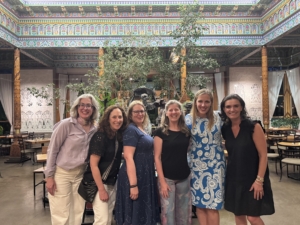
Some of the Philantherapists at dinner at the beautiful Teahouse in Boulder.

https://goodnameadvisors.com/wp-content/uploads/2025/10/GN-logo.png 0 0 472050pwpadmin https://goodnameadvisors.com/wp-content/uploads/2025/10/GN-logo.png 472050pwpadmin2026-07-30 16:19:502026-07-29 16:24:28The Philantherapists Walk Into a Room

It’s About Time

July 16, 2026

Don’t want to read? Take a listen, here.

Teacher friends of mine have always said that summer is like a long weekend. June is akin to Friday – full of possibility, relaxation, and planning. July, a Saturday. Fun outings, travel, great meals, good naps. And August? Starts like a Sunday morning, easy. And then, it creeps up and you start getting the “Sunday scaries” deep into the August heat. It gets harder to enjoy the summer as you know the excitement of fall, but yes the obligations too, are just in reach.

I’ve never been a traditional teacher, but the joys of summer as a long weekend still feel true to me. If you’ve had a meeting with me in person or on Zoom the past couple of months, you might have seen “the couch.” I love this new outdoor couch we got – it looks like a regular, upholstered sectional. It is huge! It is so comfortable. It is quick drying. And it has turned our back patio into my favorite room of the house (yes, that includes the room with our Peloton bike and tread!). And it has been where I seem to be doing my best thinking.

I’ve written lots and thought even more about marking time, and ritual. And I find myself doing just that this summer. Creating a new morning ritual of coffee and first round of email checks on the couch. Zooms on the patio. (Don’t worry — I am still covered in sunscreen.)

But rituals aren’t just the small, pleasant kind. The coffee-on-the-couch kind is easy to keep. It’s the bigger rituals — the ones that require paperwork instead of patio furniture — that we tend to let slide. Time and intention – we resolve to update our financial plan, our estate plan, our philanthropic desires. Our ethical will. And so we self-impose deadlines. Sometimes, a false deadline is what we need to accomplish the things we know we need to do.

But let’s be honest about which deadlines we keep pushing. What places and causes are close to your heart that you still haven’t solidified — not just felt, but written down, funded, acted on? If you’re 70½ or older, are you actually using your qualified charitable distributions, or is that another line item you’ll “get to”? And that donor-advised fund — how is it helping anyone by just sitting there, accruing intentions instead of impact?

The truth about a DAF is that funding it is not a decision. It’s a delay dressed up as a decision. Which is fine, for a season. But at some point the season ends, and the sitting has to become giving.

There’s a book I’ve been reading this summer, on the couch, of course — Rabbi Alan Lew’s This Is Real and You Are Completely Unprepared. The title alone stops me every time. Because isn’t that the truth about most of the deadlines we set for ourselves? We know the date is coming. We’ve known for months, sometimes years. And still, we arrive unprepared.

Lew is writing about the Jewish High Holidays — the weeks leading up to Rosh Hashanah and Yom Kippur, which Jewish tradition treats as an annual, unavoidable reckoning. Not a punishment, but a structure: a container that forces us to do the work we’d otherwise keep postponing indefinitely, whether or not we feel ready. You don’t have to be Jewish to recognize the shape of that. Every culture has some version of the deadline that doesn’t ask permission — a new year, a birthday, the start of school. That’s what a false deadline really is, I think. Not a trick we play on ourselves, but a container we build because we know we need one.

So — what’s holding you back? What do you want to accomplish this year, by the end of summer, before the container closes?

Sunday scaries are just the mind’s way of telling you the deadline is real. Let’s use it.

Shabbat Shalom,

Kari Alterman

Kari


https://goodnameadvisors.com/wp-content/uploads/2025/10/GN-logo.png 0 0 472050pwpadmin https://goodnameadvisors.com/wp-content/uploads/2025/10/GN-logo.png 472050pwpadmin2026-07-16 12:12:062026-07-17 09:08:19It’s About Time

Dreaming Out Loud (About Philanthropy)

July 9, 2026

Don’t want to read? Take a listen by clicking here.

A recent conversation with someone close to me got me thinking.

This person has it all figured out. Pre-paid funeral. Beneficiaries named on every policy, updated and correct. They have taken care of others for many years, including an adult with severe mental-health challenges. Worked hard, saved for themselves to retire the way they wanted, with travel, joy, and warm weather. And they’re the kind of person who has quietly and generously supported causes they’ve loved for as long as I’ve known them — never asked, never announced, just consistently there for the things that mattered to them.

We started talking about it all to make sure their ducks were in a row. Most of it was. But nothing in the estate plan reflected any of their philanthropic aspirations or the sustained legacy they wanted to leave behind.

Not because they didn’t care. Because no one had ever asked them to dream about it.

I think this happens more than we’d guess. People spend real effort getting their affairs in order — the policies, the beneficiaries, the paperwork — and somehow the causes they’ve spent a lifetime showing up for never make it onto the list. The generosity was real. It just never got invited into the plan.

There’s a universal truth in that: We’re often better at tending to our obligations than to our loves. We name the beneficiary. We rarely get asked to name the legacy (outside, of course, an ethical will).

So we talked — about a social-services organization that offered meaningful advice during a challenging time, but because of circumstances, never got to make good on their ideas. About a long-defunct synagogue, now with a small operating cemetery only, that gave comfort during the loss of a loved one. And about an education organization that mirrored their professional life and values, enhancing the lives of those most vulnerable. It was a conversation that brought us both great joy and comfort.

Legacy like this is what I love to dream about — to think about what has always touched your soul. The places and people to whom you want to leave a lasting thank you, an organization that gave you comfort and hope, a location that has sparked feelings of deep gratitude. How might you say thank you in a way that is truly felt?

That’s the actual work I love to do. Not just writing proposals. But sitting across from family, friends, clients, whoever’s willing — and asking the question nobody else asks: Given everything you’ve cared about, what do you want your name to keep doing after you’re not the one doing it?

I’d like you to think of someone in your life who’s generous like the person I referenced at the beginning — quietly, consistently, without needing credit. Have they ever been asked what they want that generosity to become? How they want it to endure? If not, you might be the person who gets to ask. And if you’d like company for that conversation — with them, or about someone you love — I’m here for it.

Shabbat Shalom, 

Kari Alterman

Kari


https://goodnameadvisors.com/wp-content/uploads/2025/10/GN-logo.png 0 0 472050pwpadmin https://goodnameadvisors.com/wp-content/uploads/2025/10/GN-logo.png 472050pwpadmin2026-07-09 15:36:022026-07-09 15:36:02Dreaming Out Loud (About Philanthropy)

On Patriotism and Pride

July 2, 2026

Don’t want to read? Take a listen here.

When my dad died just over four years ago, we ended his funeral service with a final blessing. It wasn’t what people expected, but for him it was the most meaningful of all prayers. I cry each time I hear it, and have for many years.

It is not always part of Jewish liturgy, and you may hear it in other houses of worship as well. When Irving Berlin wrote it as an appreciative immigrant to this country, it sat on his shelf for nearly twenty years before he felt the time was right to record it. Legend has it that he convinced Kate Smith to sing it, and the rest is history. I’m speaking about G-d Bless America.

Being first-generation American, I was taught early and often to appreciate the miracle that is this country. To recognize that it is unique in the history of the world, and as Jews, to revel in it, appreciate it, support it, and — much like we as a people believe in lifelong learning — to continue to improve upon it. No place in this world is perfect. Every country has flaws. And yet, there is no place I’d rather be than here in the United States.

I am always patriotic. That has never wavered. But engaged? Engage is something different. Engagement requires that we look honestly at what we see each day — the gaps between our ideals and our reality — and rather than look away, lean in. Have the hard conversations. Show up. And perhaps most importantly, invest.

This Fourth of July marks 250 years of this extraordinary experiment in democracy. And when I look for evidence of America at its best, one place I look is to its philanthropists — the people and institutions who see a need and meet it, not because they have to, or think they can wait for government to step in, but because they believe in something larger than themselves.

I think of Andrew Carnegie, who built more than 2500 public libraries because he believed that knowledge should be accessible to everyone. I think of Julius Rosenwald, who partnered with Booker T. Washington to build schools across the rural South at a time when the government would not — and who asked that his entire fortune be spent within his lifetime, not held in perpetuity. I think of MacKenzie Scott, who has quietly and radically redistributed billions in unrestricted gifts to organizations working on the front lines, trusting them to know their communities better than any distant donor could.

And I think of something that happened right here in Detroit.

When the city filed for bankruptcy in 2013, it faced what seemed like an impossible choice: Sell masterworks from the Detroit Institute of Arts to satisfy creditors, or devastate the pensions of municipal workers who had given their careers to this city. Detroit’s philanthropic community refused the either/or. Foundations, donors, and the DIA itself came together to raise the funds that protected both the art and the people — a Grand Bargain that showed what private generosity can accomplish when it is bold enough to try.

This is what engaged patriotism looks like in practice. Not a flag on a lawn, but a check written, a meeting attended, a cause championed. Detroit has long been a place where people invest in one another because they understand that a city, like a country, is only as strong as the people willing to show up for it. I think of the city as a public – private partnership. 

So as we mark this 250th anniversary of our country, I want to resist the urge to wring my hands at so many things that are disturbing and unnerving, and instead pick them up — to engage, to give, to lean into the discomfort of difficult conversations, and to invest in the people and places doing the work of making this country worthy of its own ideals. Whether that means giving your time, your treasure, your talent, your ties, or your testimony, there is a role for each of us.

I am patriotic always. I want to be unabashedly proud, and I believe we can be through engagement. 

G-d Bless America. May the next 250 years be worthy of her promise.

Shabbat Shalom

Kari Alterman

Kari

https://goodnameadvisors.com/wp-content/uploads/2025/10/GN-logo.png 0 0 472050pwpadmin https://goodnameadvisors.com/wp-content/uploads/2025/10/GN-logo.png 472050pwpadmin2026-07-02 15:06:452026-07-01 15:47:29On Patriotism and Pride
Page 1 of 212

Earlier Dispatches

  • On Communal – and Civic – Duty October 15, 2026
  • From the Outside In October 8, 2026
  • Youth and Wisdom October 1, 2026
  • On Building Up, and Knocking Down September 24, 2026
  • Who, Not Where September 17, 2026
  • Two Calendars, Ten Questions September 10, 2026
  • On Life and Books September 3, 2026
  • Action is the Antidote August 27, 2026
  • Future Classics August 20, 2026
  • Miscalibration August 13, 2026
  • Seasons Change. Our Giving Should, Too. August 6, 2026
  • The Philantherapists Walk Into a Room July 30, 2026
  • Well, That Was a Mistake July 23, 2026
  • It’s About Time July 16, 2026
  • Dreaming Out Loud (About Philanthropy) July 9, 2026
  • On Patriotism and Pride July 2, 2026
  • Seen. Named. Celebrated. June 25, 2026
  • Same Pieces, New Pattern June 18, 2026
  • Continuing Education June 11, 2026
  • Who (or What) is on First? June 4, 2026
Good Name Advisors

248-722-5008

Signup to receive our blog in your email!

Thank you!

You have successfully joined our subscriber list.

© 2025 - Good Name Advisors
  • Link to LinkedIn Link to LinkedIn Link to LinkedIn
Scroll to top Scroll to top Scroll to top

This site uses cookies. By continuing to browse the site, you are agreeing to our use of cookies.

OK

Cookie and Privacy Settings


How we use cookies

We may request cookies to be set on your device. We use cookies to let us know when you visit our websites, how you interact with us, to enrich your user experience, and to customize your relationship with our website.

Click on the different category headings to find out more. You can also change some of your preferences. Note that blocking some types of cookies may impact your experience on our websites and the services we are able to offer.

Essential Website Cookies

These cookies are strictly necessary to provide you with services available through our website and to use some of its features.

Because these cookies are strictly necessary to deliver the website, refusing them will have impact how our site functions. You always can block or delete cookies by changing your browser settings and force blocking all cookies on this website. But this will always prompt you to accept/refuse cookies when revisiting our site.

We fully respect if you want to refuse cookies but to avoid asking you again and again kindly allow us to store a cookie for that. You are free to opt out any time or opt in for other cookies to get a better experience. If you refuse cookies we will remove all set cookies in our domain.

We provide you with a list of stored cookies on your computer in our domain so you can check what we stored. Due to security reasons we are not able to show or modify cookies from other domains. You can check these in your browser security settings.

Google Analytics Cookies

These cookies collect information that is used either in aggregate form to help us understand how our website is being used or how effective our marketing campaigns are, or to help us customize our website and application for you in order to enhance your experience.

If you do not want that we track your visit to our site you can disable tracking in your browser here:

Other external services

We also use different external services like Google Webfonts, Google Maps, and external Video providers. Since these providers may collect personal data like your IP address we allow you to block them here. Please be aware that this might heavily reduce the functionality and appearance of our site. Changes will take effect once you reload the page.

Google Webfont Settings:

Google Map Settings:

Google reCaptcha Settings:

Vimeo and Youtube video embeds:

Other cookies

The following cookies are also needed - You can choose if you want to allow them: