
The Philantherapists Walk Into a Room
Don’t want to read? Take a listen, here.
Almost a year ago, as I was leaving my last job, I found myself in the virtual company of a small group of women who work in and around philanthropy. We started calling ourselves, half-jokingly, “the Philantherapists.” For most of the year since, we’ve mostly been names on a screen — only a few of whom I’d actually met.
So with the Purposeful Planning Institute Rendezvous – an intimate, premier conference for the many professional disciplines that help support ultra high net worth families – happening in Boulder, I flew out with the one Philantherapist attending whom I knew in real life. More of the group were headed there too, just people I hadn’t met in person yet. On the first night, six of us had dinner together. Lots of laughs, real questions, the kind of conversation that goes somewhere fast. Strangers on paper, familiar faces on a screen, but then, something else by dessert.
That dinner turned out to be a preview of how the whole conference unfolded. The facilitation by XChange was some of the best I’ve experienced: It moved you from one purposeful conversation with a single other person, into a small group, into the full room. And at every stage, you were genuinely in conversation, not just seated near one. There were reunions everywhere, old friends and colleagues finding each other again, but just as much new: new faces, new names, new thinking. It was welcoming and kind in a way that’s hard to manufacture. And it held two things at once that usually feel like a tension — real reverence for the people who built these disciplines over decades, and a sincere openness to whoever walked in this year with a new idea.
No politics, either. A small thing to name, maybe, but it was genuinely refreshing not to feel the low hum of it in the room, the way you almost always do lately. And nearly every presenter was also an attendee. The people teaching a session were sitting in the audience for the next one. No back-of-house, no separation between the people who “know” and the people who came to learn.
Philanthropy, it turned out, was only one of more than twenty disciplines represented at PPI — estate attorneys, therapists, family business consultants, filmmakers, wealth psychologists, coaches, all working inside families’ hardest conversations from different angles. And one word kept surfacing across every discipline, meaning something slightly different each time: trust. A trust is a legal document. Trust is also the thing that’s broken between siblings who haven’t spoken honestly in a decade. It’s the confidence a founder has to extend to the next generation, and the faith a family has to place in an advisor who’s about to ask them uncomfortable questions. Every conversation in that room was, in some sense, about trust — which document holds it, which relationship is missing it, and how you build more of it before you need it.
That’s where philanthropy earns its place. It’s one of the only reasons a family sits down together, generation after generation, and asks: What do we actually care about? Done well, giving isn’t a task alongside the family’s real work — it is the real work, wearing a more comfortable disguise. It’s a serious intervention for communication, unity, and shared purpose, dressed up as something everyone already wants to do. It lets people do good and feel good in the very same conversation.
I flew to Boulder knowing just a few people, and came home with the beginnings of many new friendships, a stack of new thinking, and a renewed sense of who and what my work is for.
So here’s what I keep sitting with: What would it look like if more families treated philanthropy not as a line item, but as the place where trust actually gets built — not just documented? And what’s stopping us, across all twenty-plus disciplines in that room, from saying that out loud more often? And as always, how can I help?
Shabbat Shalom,

Kari
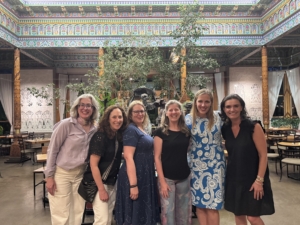
Some of the Philantherapists at dinner at the beautiful Teahouse in Boulder.
