
Future Classics
Don’t want to read? Take a listen, here.
I recently returned from a lovely trip to Pebble Beach for its annual car-week festivities. I wrote last week about the Peloton at the resort, and its overinflation of my effort in the metrics and output. Turns out, the other Peloton bike at the resort also was miscalibrated – by wildly understating my output! It all evens out in the end, but I did laugh out loud at the irony.
I was also thrilled to meet one of the Peloton instructors, Alex Toussaint, who was there as a Mercedes brand ambassador. I fangirled hard, as you’ll see in the picture below. Have I no shame? Apparently not.
In all seriousness, what was most interesting this week was the brand tagline Mercedes has adopted. They refer to their cars as “Future Classics.” It’s a clever phrase, because it does two things at once: it flatters the car you’re buying today, and it makes a quiet prediction about tomorrow. It bets on Mercedes’ incredible longevity as a brand and its ability to stay both true to form yet constantly at the leading edge, which is why its cars are so revered and collected. While it is rare to drive a new car off the lot knowing it will be collectible, the brand recognizes that its current models are likely to be celebrated 30, 50, or even 100 years from now. Of course, that status gets earned — conferred by quality, scarcity, and enduring style. It’s really a way of training your eye — asking you to see future value that the rest of the world hasn’t priced in yet.
That’s a very particular kind of vision. And it’s the same one I try to help people practice in my work.
Our Detroit Give for Good circle recently made our first grant – to help expand the Jewish community’s Be the Narrative: Student to Student program. Our giving circle appreciated the peer-to-peer focus, the many ways a young person learns to communicate who they are and what they believe in, and the potential impact of each presentation. One of the people we talked to about the program was a young woman, Lila, now in college, who participated for three years of high school. She talked about how the program shaped her worldview, her ability to speak to nearly anyone about Jews, Judaism, Israel, Kashrut, and on and on. Our investment in the program is our way of saying that we believe that this program will make a difference, and consider it a good bet to be impactful in the future.
Often, a scholarship is celebrated in the moment it’s awarded — and then, as the student matriculates and moves on with their life, it fades from memory. But its impact doesn’t fade. It ripples long into the future. The same is true, in a quieter way, of a first grant to an organization with more conviction than track record, or a gift that backs an unproven young leader before anyone else is willing to take the risk. These decisions don’t come with a badge that says this will matter. They look, at the time, like reasonable-sized checks written on faith.
And then — sometimes years later, sometimes decades — the scholarship recipient becomes the person reshaping their field. The unproven organization becomes the model others try to copy. The young leader becomes the person everyone wishes they’d backed earlier. By then, the original gift is easy to take for granted, the way few people remark on an ordinary car when it is new. The “classic” status was always going to arrive late. That’s not a flaw in the timing — it’s the whole nature of the bet.
I think about this a lot in donor conversations: part of the work isn’t just helping people give generously, it’s helping them give with future eyes. To look at a decision that feels ordinary today and ask, quietly, what might this be worth to look back on?
There’s a story in the Talmud about Honi, who plants a carob tree in his old age. When asked why, as he’ll never enjoy its fruit, he speaks of it as a gift for those who will enjoy it in the future.
So here’s what I’m sitting with, coming home from this trip: What might you invest in today, to change tomorrow? And how might I help you achieve that vision?
Shabbat Shalom,

Kari
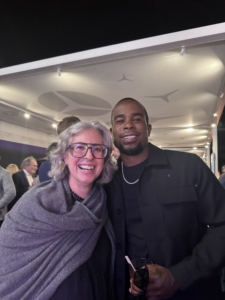
Me and Alex Touissant. NIIIICE!
