
Seasons Change. Our Giving Should, Too.
Don’t want to read? Take a listen, here.
I’ve been thinking recently about the end of summer (I know, I know, it’s only the first week of August) and about how quickly time seems to slip away. We know you can’t go back in time, but you can revisit places that shaped you. And sometimes, those places still have something to teach.
I recently had the chance to spend a few hours at the “happiest place on earth,” aka Tamarack Camps. I wasn’t a camper at main camp, but some of the most formative years of my young adulthood were spent there. I was a counselor to middle school and early high school kids, supervised a village of them, and then spent the summer before graduate school as a counselor on the Alaska trip. Together with two other counselors (still dear friends), we drove a bus full of teenagers from the Detroit suburbs to Alaska and back. Every night we pitched camp, made our own meals, hiked, kayaked, explored, solved problems, and somehow managed to keep everyone alive. (I even hitchhiked once. Don’t ask. It all worked out.)
The lessons from those summers have stayed with me ever since. There are plenty of articles about what camp teaches young adults: how to manage people, navigate conflict, deal with overbearing parents, and somehow make each day feel like three distinct days marked by breakfast, lunch, and dinner. As a staff member, we were constantly reminded that “camp is for the kids.” Even at twenty, I knew that wasn’t entirely true. Camp was for us, too. We were building lifelong friendships, learning to lead, and figuring out who we were.
Years later, I realized I’d missed another audience entirely. Camp is also for parents. It’s a chance to regroup, to deep-clean the house, to rediscover what evenings feel like without children’s schedules humming in the background. (Have you seen Marcello Hernandez’s bit about parenting tweens? One of the funniest—and truest—things out there.)
Walking around camp last week, though, I realized there was yet another lesson.
Camp has never really been for just one group. It has evolved because every one of those groups has changed. Today’s campers have different needs than they did thirty years ago. Counselors who spent formative years navigating COVID bring different strengths and different challenges. Parents are raising children in a world that asks something different of them than it asked of previous generations. The mission of camp hasn’t changed, but the way it serves people has. It has adapted because the people it serves have adapted.
It struck me that we don’t always give ourselves that same permission.
Many of us made our philanthropic decisions during a different season of life. We had young children (or no children). Aging parents. Different financial realities. Different interests. Causes that once felt deeply personal may no longer be at the center of our lives, while new issues have emerged that keep us awake at night. And yet our giving has a funny way of becoming permanent. Annual checks get written because they’ve always been written. Monthly gifts quietly renew. Organizations remain on our list because they’ve been there for years.
Loyalty is a wonderful thing. But intentionality is even better.
Every so often, it’s worth asking whether our giving still reflects who we are today. What organizations continue to earn your confidence and support? What causes genuinely energize you? Which commitments have become habit rather than conscious choice? And what new opportunities deserve a place in your philanthropic life?
Just as many families spend part of the summer cleaning out closets before another busy season begins, perhaps this is also a good time to revisit our charitable giving—not necessarily to give less or even differently, but to make sure it still reflects the values, priorities, and passions we hold today.
Camp reminded me last week that growth doesn’t mean abandoning what matters. It means taking the time to make sure what mattered then still reflects who we are now.
Shabbat Shalom,

Kari
P.S. If you’ve been wondering whether your giving still reflects your values—or if you’d simply like another set of eyes on your philanthropic priorities—I’d be happy to help.
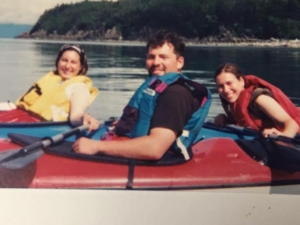
Me and my co-counselors kayaking in Alaska.
